
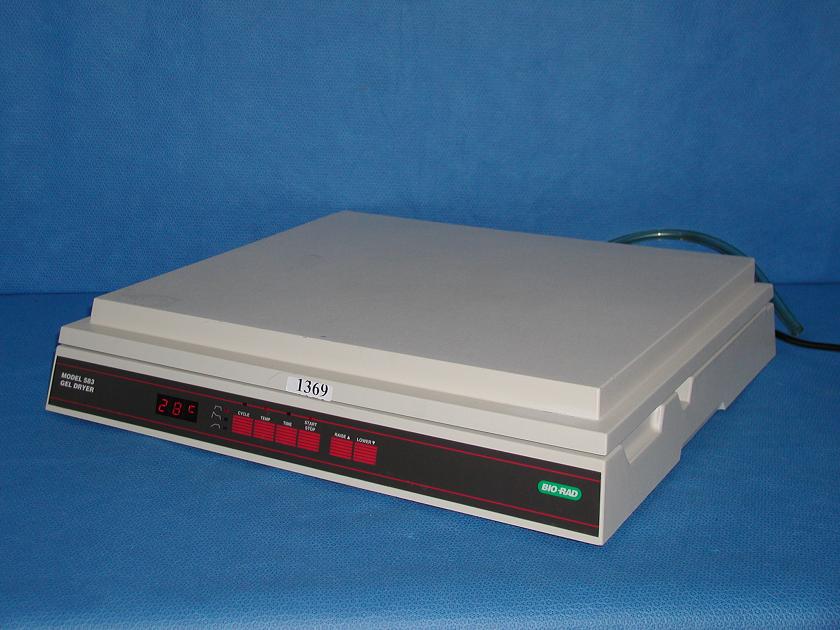
Bio-Rad 583 Gel Dryer
Item Number:
1369
Manufacturer:
Model:
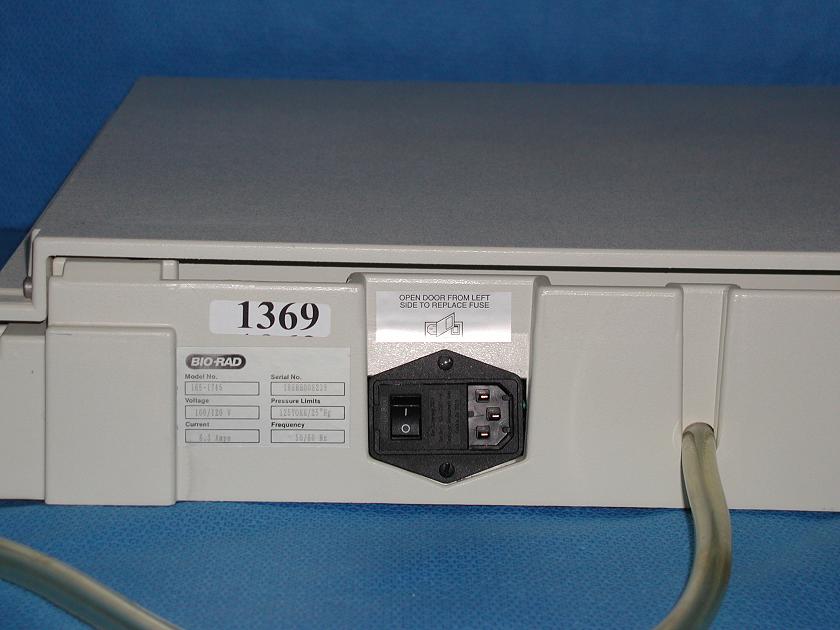
165 - 1745
Condition:
Used
Power Supply:
110-120 V, 6.3 A, 50, 60 Hz


Specifications:
The Bio-Rad Model 583 Gel Dryer, along with the Bio-Rad HydroTech Vacuum Pump, is used in our lab primarily to dry polycacrylamide gels of all types. This gel dryer, which is 11 X 55 X 50 cm with a drying surface of 35 X 45 cm, has the capacity to dry 9-16 mini-gels or 2 large-format gels (e.g. gel-shift gels) or 1 sequencing gel. The 583 Gel Dryer consists of a lid with a heating element, a transparent rubber sealing gasket, which allows one to observe the gel during drying and a porous gel support through which the vacuum is applied.
The gel dryer's operating temperature range is 50 - 90 C and it has an operating time range of 5 minutes to 9 hours and 55 minutes. There are 3 programmable drying cycles: 1) the sequencing cycle which decreases the sequencing gel drying time, 2) the gradient cycle which increases the temperature slowly to prevent gels from cracking and 3) the PAGE gel cycle which is used for most routine gel drying. Our lab primarily uses the gradient cycle to dry coomassie-stained mini-gels. Because these gels are thin, they tend to crack easily, but we've found that if we're careful and apply saran-wrap to the gel with two pieces of filter paper beneath it (Bio-Rad recommends using wet filter paper), than we can avoid this problem.
The gel dryer's operating temperature range is 50 - 90 C and it has an operating time range of 5 minutes to 9 hours and 55 minutes. There are 3 programmable drying cycles: 1) the sequencing cycle which decreases the sequencing gel drying time, 2) the gradient cycle which increases the temperature slowly to prevent gels from cracking and 3) the PAGE gel cycle which is used for most routine gel drying. Our lab primarily uses the gradient cycle to dry coomassie-stained mini-gels. Because these gels are thin, they tend to crack easily, but we've found that if we're careful and apply saran-wrap to the gel with two pieces of filter paper beneath it (Bio-Rad recommends using wet filter paper), than we can avoid this problem.
Find similar items in the Electrophoresis category.
See more:
Price enquiry:
Please fill in the following form and we will get back to you very shortly with a quotation:
Fields marked with * must be filled!